
Whisky Production
Whisky production
Whisky is known all over the world today. Its origins, however, lie in 5th-century Ireland and Scotland. The term itself derives from the Scottish Gaelic word uisge beatha or uschkeba, or from the Irish uisge/uisce beatha. In English we would speak of the water of life. The anglicised spelling usquebaugh, just like the Gaelic variant, can be found in many place names. In the past, the term whisky referred not only to today's variants but also to spirits to which spices had been added.
Scottish tax records show that in 1494 whisky was referred to as aquavite. A Benedictine monk had bought eight bolls of malt at the time. Eight bolls correspond to roughly 500 kilograms of malt today. Up to 400 bottles of whisky could then be made from this.
Raw materials required
Whisky is matured in casks. As these are used several times, they always impart a very individual aroma. At the same time, the diversity of aromas depends on various influencing factors. In addition to cask maturation, these are the raw materials chosen and the production process itself.
Water is an important component in whisky production. Most distilleries use water from a nearby spring. The quality of the water depends, among other things, on its mineral content, hardness, any peat content and microorganisms. An existing spring was usually a deciding factor in choosing the site of a distillery.
The most important raw material, however, is the grain. Depending on the production process and type of grain, it is used either malted or unmalted. Many whisky producers use malted barley, whose quality is divided into a total of 9 grades. Only barley of grades one to three can be used for malting. Decisive factors for the grading include a high starch content, a low nitrogen and protein content, uniformity of the grains, a high germination rate and the ripeness of the barley.
Another important ingredient is yeast, more precisely the baker's yeast Saccharomyces cerevisiae. Through its enzymes, the yeast converts the sugar into alcohol and carbon dioxide. At the same time, it produces other substances during fermentation that also affect the aroma.
Steps in whisky production
Whisky is made in several steps, which differ depending on the distillery, region and country, or are carried out in modified form. First, the grain is prepared, for example by malting. Maize can also be cooked.
Infographic: the whisky production process
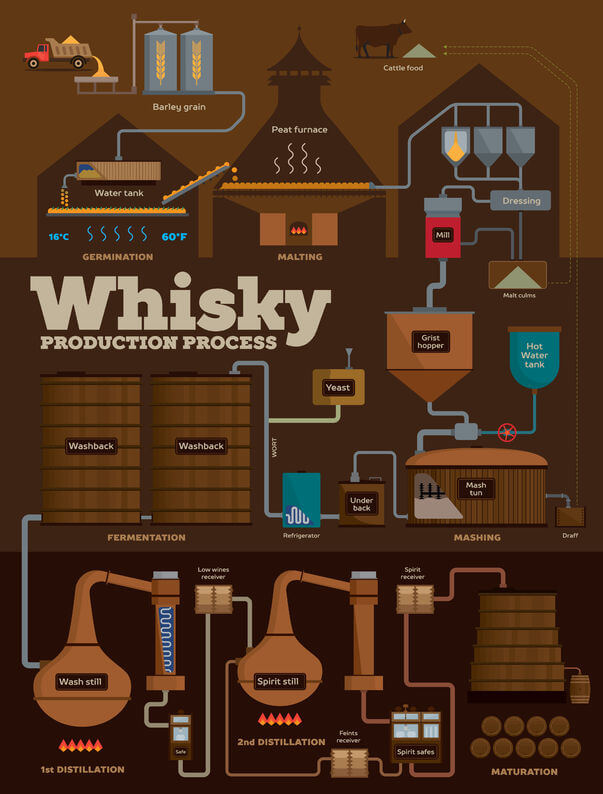
Step 1: Malting
The barley or other grain is spread evenly on barn floors (the so-called malting floors), moistened with water and left to germinate. During germination, enzymes are activated that convert the starch into malt sugar. As this generates heat, the grains must be turned regularly. Germination is then stopped by applying heat and the malt is dried. Hot dry air, hot smoke or peat can be used for this. The components contained in peat, such as decayed mosses and heather, release very special flavour compounds through the smoke.
Step 2: Milling and mashing
The grain is only ground into grist shortly before mashing. It is then placed in the mash tun together with hot water and mixed. During mashing, the starch is converted into malt sugar. All fermentable sugars are to be extracted during mashing. The mash tun has a perforated base through which the sugar-rich liquid can drain. Once this liquid has cooled, it is pumped into a fermentation vessel, where the baker's yeast is added.
Step 3: Fermentation
In whisky production, fermentation proceeds much as it does in beer brewing. However, no purity law applies here, so whisky production does not have to be low in germs. The resulting wash has an alcohol content of approximately 5 to 8 per cent by volume. It is filled into so-called washbacks.
Step 4: Distillation
Fermentation is followed by distillation. Here the liquid first passes through a copper still in which the low wines are produced, reaching an alcohol content of approx. 20 per cent by volume. The liquid is then filled into a second still, also made of copper, and the process is repeated. In the process, the alcohol and most of the aroma and flavour compounds are separated from the water and concentrated. The stillman then separates this spirit into the middle cut, the heart, the foreshots and the feints. The heart then flows through a spirit meter, which is required to calculate the spirits duty payable. The middle cut usually reaches an alcohol content of 60 to 75 per cent by volume. In some cases the new make is reduced with water and then filled into wooden casks.
If a still is damaged, care is taken to ensure that the new still has exactly the same shape as its predecessor.
Whisky production in Japan
Around the mid-1920s, Japan also began to produce whisky. Particularly in the northern parts of the country, there are a number of distilleries that offer their spirits not only regionally but also internationally. Japan mainly produces single malt. The country's largest distilleries include Suntory and Nikka, whose spirits are, of course, also available in our online shop.