
Types of Whisky
All types of whisky at a glance
Single malt and blended malt are undoubtedly among the best-known types of whisky. There are, however, other types of whisky – some of them consumed only regionally – which we would also like to introduce briefly in this article. Perhaps you will decide to try one or two of them yourself when the opportunity arises.
Note: although both the spellings whisky and whiskey are in common use, for the sake of simplicity and clarity we have opted for the spelling whisky.
Simply and quickly select the type of whisky you would like to find out about.
- Single Malt
- Blend
2.1 Blended Malts
2.2 Blended Grains
2.3 Blended Scotch - Blended Malt or Pure Malt
- Malt Whisky
- Bourbon Whiskey
- Tennessee Whiskey
- Tennessee Sour Mash
- Corn Whiskey
- Malt
- Rye Whisky
- Grain Whisky
- Pure Pot Still
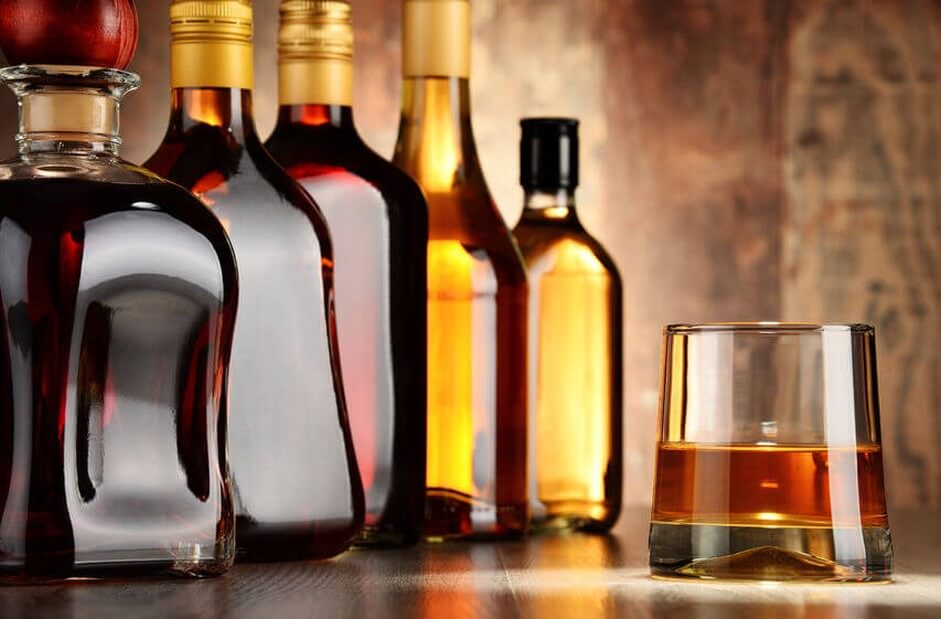
1. Single Malt
Single malts always come from a single distillery. They may, however, quite possibly be a vatting of different casks. This ensures a consistent flavour over the years. Malted barley is used in production, which is also where the word malt comes from. As a rule, this type of whisky is matured for years, sometimes even for more than a decade, before it goes on sale.
Single malts – unlike blends – are known for their own, very individual character. This character is determined both by production and by maturation. Caramel colouring is often added to obtain a more intense colour. In some countries, for example Germany and Denmark, the addition of caramel colouring must be stated on the label.
The barley used for malting does not necessarily have to come from the vicinity of the distillery. It has only a minor influence on the character of the distillate. The water, on the other hand, usually comes from the immediate surroundings. Before the single malt is bottled, it is usually necessary to add water to reduce the whisky to drinking strength.
Single malt producing countries include Ireland, Scotland, the USA, Canada, Japan and continental Europe, among others. In Japan in particular it is enjoying ever greater popularity, as you may already have seen in our shop offers. More detailed information about single malt whisky can be found in the article linked here.
2. Blend
A blend is a mixture or vatting of different whiskies. Very often grain whisky is used as the base, to which up to 50 whiskies are added. The so-called master blender is responsible for the composition of the whisky and checks it at regular intervals, much as the brewmaster does in beer brewing.
After distillation, the blend is matured for some time in wooden casks so that the flavours of the different whiskies combine. It makes sense always to mature the blend in the same casks.
It is believed that the invention of whisky blending goes back to Andrew Usher senior and Andrew Usher junior. In 1853 the father created his first „Old Vatted Glenlivet“ blend from various single malt whiskies. Three years later Andrew Usher junior also added grain to the whisky. The „Usher’s Green Stripe“ he created is still available today.
In Scotland a distinction is made between blended malts, blended grains and blended Scotch.
2.1 Blended Malts
Blended or pure malts are made or vatted exclusively from different single malt whiskies from several distilleries. In the past these were also known as vatted malts. A more detailed description can be found in the glossary entry under blended malt or pure malt whisky (coming soon, as of 06/03/2017).
2.2 Blended Grains
Blended grains are vatted exclusively from grain whiskies from different distilleries. Unlike blended whiskies, no single malt is added to blended grains.
2.3 Blended Scotch
Blended Scotch is blended from grain whisky and one or more single malt whiskies. The best-known blended Scotch whiskies include Ballantine’s and Johnnie Walker Red Label.
3. Blended Malt or Pure Malt
The term blended malt (abbreviated to blend) or pure malt refers to a vatting of several whiskies. This may consist exclusively of malt whiskies, but may just as well be a mixture of malt and grain whiskies. It is quite possible for a blend to consist of whiskies from 50 different distilleries. For premium blends, considerably older and therefore more mature whiskies are often used. Blending gives the whisky a consistent character every time.
4. Malt Whisky
Malt whisky is made exclusively from barley. This is first made to germinate, which in technical terms is called malting. In traditional production, the barley is dried or kilned over smouldering peat fires. This gives malt whisky its well-known smoky flavour. Once the malt has been dried, it is milled before water and yeast are added. The yeast causes the mixture to ferment. The resulting liquid is distilled twice in onion-shaped copper stills (the „pot stills“). Not only the quality of the barley and the drying process over the fire, but also the water used is of enormous importance in malt whisky production.
Malt whisky distillates are usually matured in wooden casks for between eight and twelve years. The long maturation provides the more intense colour and flavour. The bouquet is also influenced by the climate, as air penetrates through the wooden casks. At the same time, all the substances that make the distilled spirit taste harsh or aggressive also evaporate.
As a rule, a master blender decides when the malt whisky distillate, as well as any other whisky distillate, has fully matured. Depending on geographical origin, a distinction is made between Highland, Lowland, Islay and Campbeltown malt whiskies.
5. Bourbon Whiskey
Bourbon whiskey must be made from at least 51 per cent and at most 80 per cent maize. In many places the proportion of maize in the mash is between 65 and 75 per cent, which is then supplemented with rye or possibly wheat. If the whiskey is to be sold as straight bourbon, a statutory maturation period of two years is prescribed in the USA. This must take place in new white oak casks that are charred on the inside. Bourbon whiskey reaches maturity after only a few years.
Unlike rye and other types of whisky, bourbon whiskey may only be produced in the USA.
6. Tennessee Whiskey
Tennessee whiskey is a sub-type of bourbon whiskey. Unlike bourbon, however, it may not be produced throughout the United States, but only in the state of Tennessee. Unfortunately, only a few whiskey distilleries remain there. The best known include Jack Daniel’s and Benjamin Prichard’s.
Special features after distillation: some whiskeys produced in Tennessee are treated in a very special way after distillation. They undergo the so-called „Lincoln County Process“, in which the whiskey is filtered through thick layers of charcoal before being matured in the cask.
7. Tennessee Sour Mash
Two different types of whiskey are produced in the USA: on the one hand bourbon whiskey, on the other Tennessee sour mash. The raw materials and the distillation method are quite comparable with those of bourbon whiskey. Just like Tennessee whiskey, however, Tennessee sour mash may be produced in this US state. After distillation, the whiskey undergoes a special procedure, the „Lincoln County Process“. Here the distillate is filtered through a layer of charcoal several metres high, thereby acquiring additional aromas.
8. Corn Whiskey
The term corn whiskey refers to whiskeys with a maize content of at least 80 per cent. It is still little known in Germany at present. In terms of flavour, it resembles bourbon and Tennessee whiskey. These two types, however, need only contain a maize content of at least 51 per cent. Corn whiskey tastes quite sweet, relatively light and less spicy than, for example, a rye or bourbon whiskey. Just like these, however, it may only be distilled to a maximum of 80% vol. Whisky connoisseurs also see in it a certain closeness to the so-called „moonshine whiskeys“, which were formerly distilled illicitly. The distilled whiskey can be matured in both new and used wooden casks, which is not permitted for bourbon and rye. These two types of whiskey may only mature in new casks. Corn whiskey matured in new casks is, incidentally, referred to as straight corn whiskey.
9. Malt
Malt is the term used for whiskies made exclusively from malted barley. A more comprehensive explanation can be found under the term malt whisky.
10. Rye Whisky
Rye whisky is made mainly from rye. The mash must contain at least 51 per cent rye. These distillates are mainly produced in the USA and Canada, although in Canada there are no statutory restrictions on content. There, for historical reasons, any Canadian whisky may bear the designation rye whisky, regardless of whether the mash contains any rye at all.
Rye whisky is one of the oldest North American types of whisky. Above all until Prohibition, it was the most widely consumed type of whisky in North America. In recent years it has been enjoying growing popularity again, which is no doubt also attributable to the rise of single malts and a wider choice. Production increased sixfold in the period from 2009 to 2014 alone, from 88,000 cases to 561,000 cases. One case contains 9 litres.
Overall, rye whisky tastes spicier, more bitter and drier than bourbon whiskey. It must be matured for at least two years in new charred oak casks, and its alcohol content may not exceed 80% vol. Most of it is used to produce blended whiskies. At the same time, it is also used as an ingredient in cocktails, to which it lends a more intense and drier aroma than, for example, a bourbon whiskey.
A special case is the Old Potrero Rye Whisky from Anchor Distilling, based in San Francisco. Its mash consists exclusively of rye. This whisky is sold both as a one-year-old and as a three-year-old „Straight Rye“.
In Canada, all whiskies used to be made with a high proportion of rye. In recent decades, rye has mostly been replaced by maize or wheat. Nevertheless, these distillates may also bear the designation rye whisky, as the legal regulations for Canadian rye whisky and Canadian whisky are identical. They make no reference to the raw materials of the distillate.
11. Grain Whisky
Grain whisky refers to distillates made from wheat, unmalted barley and other cereals. While in Europe mainly oats are added, rye or maize (the latter only in the USA) is added to Canadian and US grain. Production uses the so-called patent still process. Grain distillates are mainly used to produce blended whiskies, but are also available as single grain whisky, where, however, they are a niche product.
12. Pure Pot Still
Pure pot still is undoubtedly one of the most traditional Irish whiskeys. It is made largely from unmalted barley. The mash is distilled a total of three times in copper stills, the so-called „pot stills“. This produces the soft, pure and sometimes slightly oily character for which Irish whiskey is world-famous.
The designation pure pot still has not been in use for very long and serves to distinguish it from pot still whisky, which is usually a blended whisky.
Pure pot still whiskey is a rarity; only a few producers make this special type. The best-known brands include Redbreast and Powers. Redbreast Irish Whiskey in particular is highly regarded worldwide, not least by whisky connoisseurs.