
Single Malt Whisky
This part of our whisky guide is all about single malt whisky. What does single malt actually mean? How does it differ from other types of whisky, such as pure malt and blends? This page answers the most frequently asked questions.
What is single malt whisky? A definition
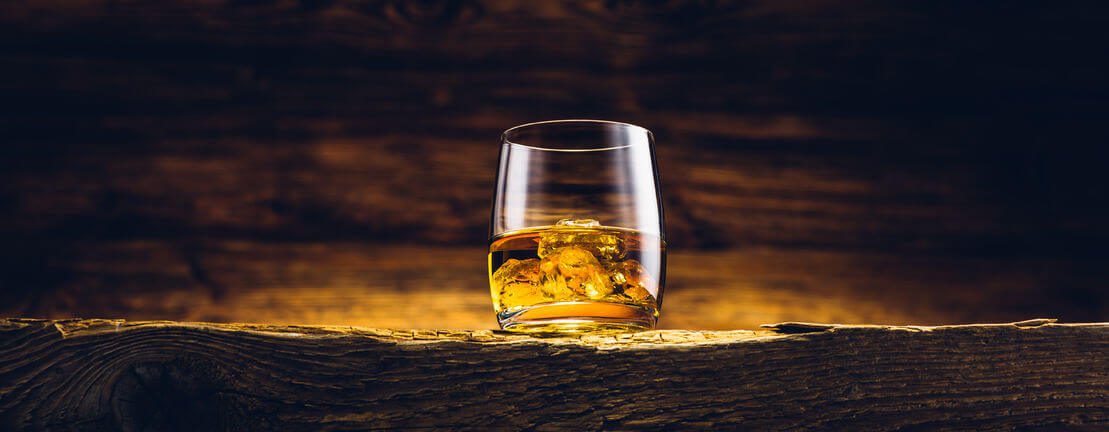
Whiskies that are to bear the designation single malt must meet two conditions. They must come from a single distillery, so they may not be a blend of several whiskies. In addition, only malted barley may be used to make single malt whiskies. The word single therefore stands for one distillery, and the term malt for malted barley.
Whiskies bearing the designation single malt are regarded as particularly high quality. At the same time, they are matured for an especially long time; their maturation period may well be ten years or longer.
A single malt whisky may quite possibly be a vatting of different casks from a single distillery. This achieves an almost consistent nose and flavour. The age statement on the bottle usually refers to the youngest whisky in the vatting.
1. Differences from blends
In contrast to a blend, which can be reproduced for years, single malt whiskies have a very individual character. This depends above all on production and maturation. To obtain a more intense colour, caramel colouring is usually added to the whisky. In some countries, for example Germany and Denmark, this must be stated on the label.
The barley itself has only little influence on the character of a single malt. It does not necessarily have to come from the immediate area. The water used for production usually comes from the immediate surroundings of the distillery. For many distilleries, breweries and other beverage producers, having their own spring was the very basis for their foundation.
Before the single malt whisky is drawn from the casks and bottled, water is added to reduce it to a drinkable strength.
2. Legal requirements
Under the Scotch Whisky Act of 1988 and EU Regulation 1576/89, the alcohol content of whisky must be at least 40% by volume.
At the same time, a minimum maturation period of three years is prescribed for Scottish single malts. In the USA, only oak casks may be used for maturation.
Just like all other types of whisky, single malt is drunk at room temperature, either neat or with a little soft spring water. Only in this way can the complex nuances of flavour be fully appreciated.
3. The largest single malt producing countries
Single malt – just like whisky in general – is produced on a larger scale in only a few countries. The most important producing countries are briefly listed below.
3.1 Scotland
The first whisky was probably distilled in Ireland. Monks then brought the recipe to Scotland in the Middle Ages, which over time became the largest producer of single malt and of whisky in general. There are still more than 100 distilleries in the country.
After production had been sharply reduced or discontinued around the middle of the 19th century, the Scottish company Glenfiddich brought a single malt back onto the market in 1963. Today Scotch single malt whiskies account for a ten per cent share, while blends make up 90 per cent of Scotland's total whisky production.
3.2 Ireland
Naturally, single malt whisky continues to be produced in Ireland as well. Production hardly differs from the Scottish variant. In contrast to Scotch, Irish whiskey is distilled three times in total in continuously running stills, while Scotch is usually distilled twice in batch-operated stills. Whereas in Scotland peat fires are generally used to dry the malted barley, in Ireland drying is done with hot air. As a result, the whiskey tastes less smoky.
3.3 Japan
Single malt has also been produced in Japan since the 1920s, above all in the cooler north. Rice cannot be grown there, which is why the region has specialised in growing European cereals since the 19th century. Japanese whisky is very popular in its home country, but is also increasingly in demand internationally. The world's largest whisky distillery is located in the Japanese city of Osaka.
3.4 Continental Europe
On the European mainland, whisky production is only a marginal phenomenon. The share of single malts is correspondingly small. In Switzerland, Austria and also Germany there are a few distilleries that specialise in whisky production.
3.5 USA and Canada
In the USA and Canada, whisky is made from malted barley only to a very limited extent. Much more often rye, maize or a mixture of different cereals is used. The share of single malts is therefore likely to be small. As whisky production in the USA is dominated by a few large producers, hardly any blends from different distilleries are available there.